Storage and pantryUpdated
Small Kitchen Storage Ideas: Where the Space Actually Is
Quick picks
- Best overallYouCopia UpSpace Adjustable Shelf Riser
An adjustable shelf riser, 16 inches wide and 9 inches deep, with 3.7 to 5.7 inches of clearance underneath and steel wires that hold up to 25 pounds.
Check price on Amazon: YouCopia UpSpace Adjustable Shelf Riser (opens in a new tab) - Best budgetCopco 18-Inch Lazy Susan Turntable
A nonslip rotating tray eighteen inches across with a rimmed edge, sized for the back of a deep cabinet.
Check price on Amazon: Copco 18-Inch Lazy Susan Turntable (opens in a new tab) - Worth the upgradeOXO Good Grips 10-Piece POP Container Set
Ten stackable airtight canisters with push button lids in mixed sizes, for the handful of staples you open every week.
Check price on Amazon: OXO Good Grips 10-Piece POP Container Set (opens in a new tab)
Small kitchens are rarely short of space. They are short of reachable space. Where the unused volume hides, what to put in it, and what no organizer will fix.
Almost every small kitchen has more space than it appears to. What it lacks is space you can reach without moving something else first.
That distinction changes what the fix looks like. If the problem were volume, the answer would be to own less. Usually the volume is there, in awkward shapes, at awkward heights and behind other things, and the answer is to change the shape of the storage rather than the quantity of the contents.
This guide shows where the unused space hides, the five organizers worth buying and the order to buy them in, and, just as plainly, the problems no organizer will fix.
The picks
The three Quick picks come first. If you are starting from nothing, the buying order further down is the one to follow: riser, turntable, knife bar, under-sink caddy, and airtight containers last.
YouCopia UpSpace Adjustable Shelf Riser
An adjustable shelf riser, 16.0 inches wide, 9.0 inches deep and 7.7 inches high, with steel wires that hold up to 25 pounds. The clearance underneath adjusts from 3.7 to 5.7 inches, and it snaps together without tools and stands on non-slip feet.
Stack two dinner plates on a shelf with a twelve inch gap and you have used two inches and blocked ten. A riser turns one usable surface into two with no installation, and the adjustable height means the lower level can be set to what actually lives there: mugs, small bowls, cans or a short stack of side plates.
Worth knowing: Measure twice. The shelf needs nine inches of depth, and the gap above it needs room for the riser plus whatever stands on top. Keep the 25 pound limit in mind if the top level holds heavy stoneware. It is hand wash only.
Skip it if: your shelves are already close together, or the cabinet is shallower than nine inches.
Copco 18-Inch Lazy Susan Turntable
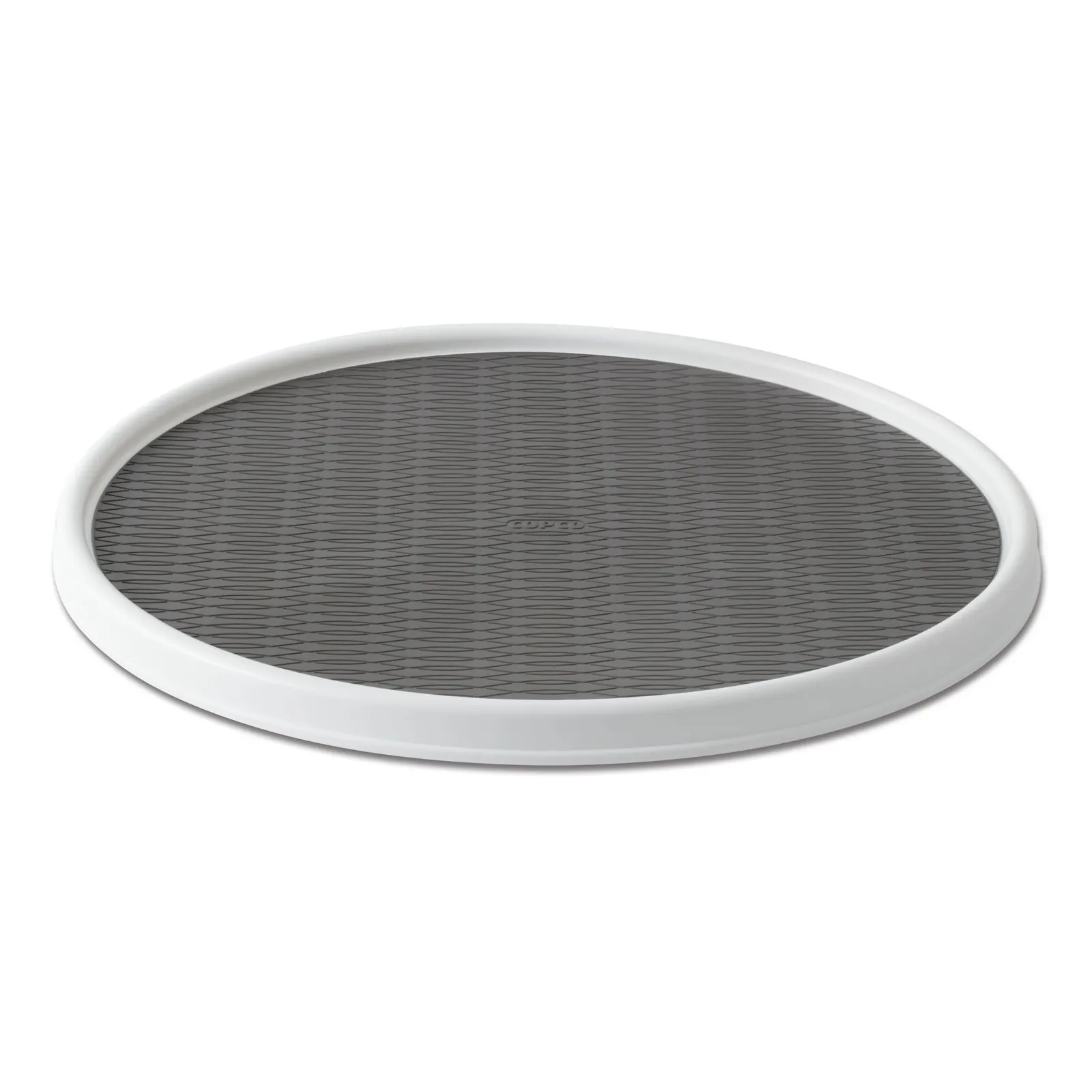
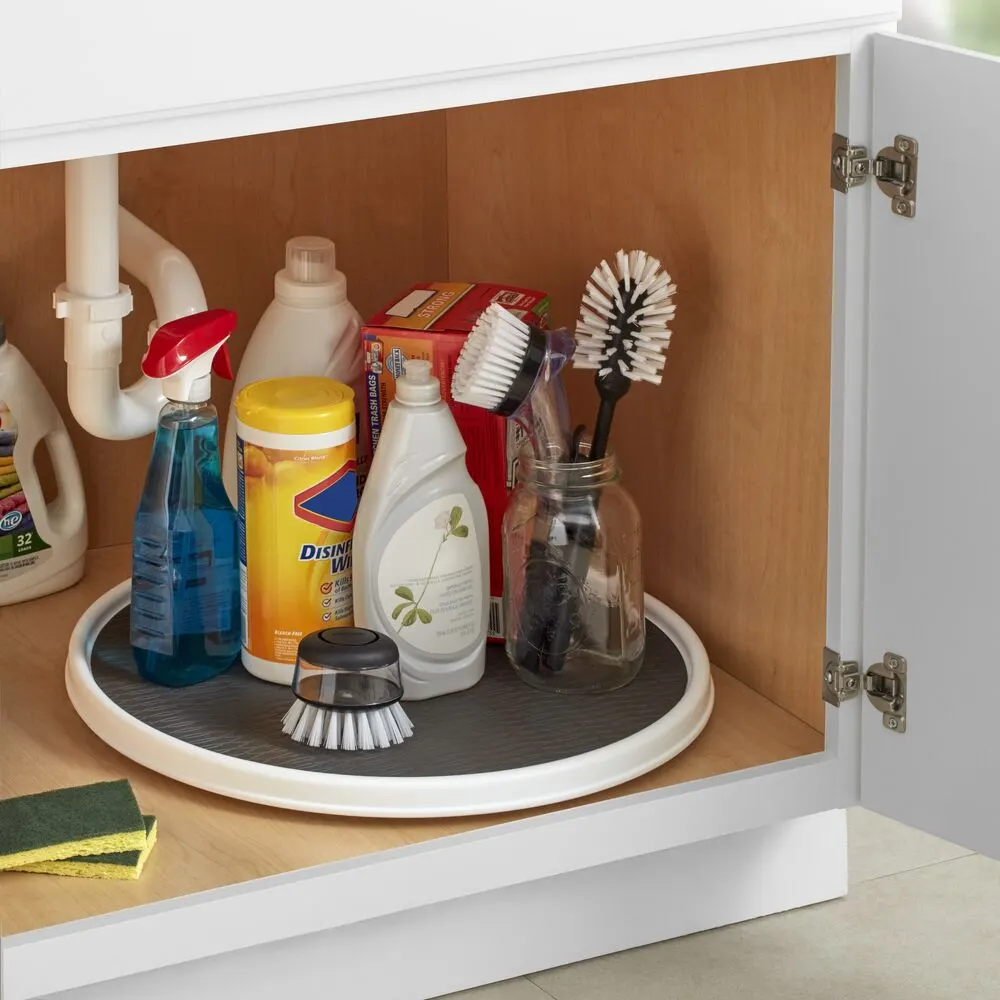
A nonslip rotating tray for a deep cabinet, eighteen inches across, with a rimmed edge.
A deep corner cabinet is where food goes to be forgotten. A turntable brings the back to you in one spin, so oils, vinegars and jars stop hiding behind each other, and the rim keeps bottles from sliding off as it turns. It is the highest-return thing you can put inside a single cabinet.
Worth knowing: Measure the door opening, not only the shelf. Eighteen inches will not pass through a narrow cabinet door, and a corner cabinet with a center post may not let it turn freely.
Skip it if: the cabinet is under eighteen inches in width or depth, or most of what goes in it is square boxes, which waste a round tray's edges.
OXO Good Grips 10-Piece POP Container Set
Ten stackable airtight canisters with push button lids, in mixed sizes.
Flour, sugar, oats, rice, pasta and coffee earn decanting: you open them often, they keep better sealed, and square containers stack where bags slump into each other. Clear sides are a feature inside a cabinet, because what you are really buying is visibility, the ability to see at a glance what is running low.
Worth knowing: This is last on the buying list for a reason. Decanting adds a step between the shopping bag and the shelf, and steps that exist only for looks get skipped when you are tired. Check the size of each piece on the listing against the bags you buy before relying on one for a whole bag of flour.
Skip it if: you have not sorted the pantry yet. Sort first, measure the shelf, and then decide whether you need ten pieces or four.
Modern Innovations 16-Inch Stainless Steel Magnetic Knife Bar
A 16 inch bar of satin-finished stainless steel with a fully magnetic surface powered by a neodymium magnet.
Counter space is the scarcest thing in a small kitchen, and a knife block takes a corner of it for good. A knife bar puts the same knives on the wall, within reach and out of the way, and it is usually the first change that gives counter back.
Worth knowing: It has to be fixed to the wall, so check how it mounts and, if you rent, what the lease allows. Keep it clear of the stove and out of reach of small children.
Skip it if: your knives already live in a drawer and the counter is not where the squeeze is.
YouCopia RollOut Under Sink Caddy, 8 inch
A rolling bin 7.7 inches wide, 5.3 inches high and 16.4 inches deep (21.3 inches with its basket), sized for standard lower cabinets. It holds up to 30 pounds and has handles, back wheels, adjustable dividers and a removable hanging basket.
Under the sink there is a pipe through the middle, which is why nothing fits and everything gets dropped in loose. This caddy is narrow enough to fill the strip beside the pipe and pulls out by its handle, so the bottles at the back come forward in one movement instead of one at a time.
Worth knowing: It is not a two-tier shelf, so it does nothing for the height above it. Pair it with a tension rod across the back to hang spray bottles by their triggers. Check that the cabinet is 21.3 inches deep if you want the basket on. It is plastic, hand wash only.
Skip it if: the sink cabinet has a wide clear floor on both sides of the pipe, where a two-tier shelf with a pipe cutaway uses the space better.
How they compare
| Pick | Best for | Key spec | Trade-off |
|---|---|---|---|
| YouCopia UpSpace riser | Doubling the usable surface of a tall shelf | 16 x 9 in, 3.7 to 5.7 in clearance, holds 25 lb | Needs nine inches of shelf depth |
| Copco turntable | Bottles and jars in a deep corner cabinet | 18 in across, nonslip, rimmed edge | Too wide for narrow cabinet doors |
| OXO 10-Piece POP set | Staples you open every week | Ten airtight, stackable canisters | Adds a decanting step; buy it last |
| Modern Innovations knife bar | Taking the knife block off the counter | 16 in stainless steel, magnetic along its length | Has to be fixed to the wall |
| YouCopia RollOut caddy | The strip beside the pipe under the sink | 7.7 in wide, holds 30 lb, back wheels | Uses floor space only, not height |
How to choose
Measure three things before buying anything
The door opening, the interior depth and the height between shelves. Most organizer mistakes are a riser that sits too tall for the gap above it or a turntable that will not fit through the door.
Freestanding before fixed
Risers, turntables, caddies, tension rods and adhesive hooks do most of what fitted storage does and leave with you when you move. Anything that drills into a rented kitchen is worth checking before you buy it.
Visibility over matching
Clear or open beats pretty. The thing you cannot see is the thing you buy a second one of, and a cabinet you can read at a glance stays organized longer than one that only looks good with the door shut.
Buy in order of return
- A shelf riser, or two or three. Immediate, no installation.
- Open bins to group loose items by category in cabinets and the refrigerator. See-through matters more than pretty.
- A magnetic knife bar or a wall rail. The first thing that gives you counter back.
- An under-sink caddy or a two-tier organizer with a pipe cutaway.
- A turntable for the corner cabinet or the condiment shelf.
- Airtight containers, last, and only for the five or six things you use every week.
Where the unused space hides
The vertical gap in every cabinet. Look at each shelf and ask how much of the height between it and the one above is actually occupied. Anywhere the answer is under half, a riser or an under-shelf basket belongs there. Across a whole kitchen it is usually the largest single loss.
The insides of doors. Flat, vertical and almost always empty. An over-the-door rack or a few adhesive hooks take pot lids, foil boxes or measuring spoons, as long as the door still closes past the shelf behind it and is solid enough to carry the weight.
The wall. A knife bar removes a knife block, a hanging rail takes utensils and a scale out of a drawer, and a narrow shelf above the counter holds spices in depth that was doing nothing. Tools hung deliberately also read as intentional, which is why the fall baking aesthetic guide leans on the same move.
Deep corners. Spin or pull, never stack. If reaching the thing at the back means removing the thing at the front, the thing at the back is not stored, it is buried. A shallow bin you can lift out entirely beats a deep one you have to reach into.
Pantry organization that survives real life
Decanting everything into matching containers looks wonderful and often fails within a month, for a predictable reason: it adds a step, and steps that exist for appearance get skipped.
Decant only what you use constantly. Flour, sugar, oats, rice, pasta, coffee. Leave everything else in its packaging and corral it by category in open bins. A bin labeled baking that you lift out whole is faster than twelve individually beautiful jars.
Label the lids, not the fronts. You look down into a shelf more often than straight at it, and lid labels survive rearranging.
Put the expiry-sensitive things at eye level, where you will see them before they turn.
What organizers do not fix
Owning more than the kitchen holds. No riser makes room for an appliance that has not left the cabinet in a year. That one needs a new home, not a better shelf.
A pantry or drawer you have not sorted. Containers and dividers bought first get the sizes wrong and hold things that should not be going back in. Sort, measure, then buy.
A system nobody keeps up. If putting the shopping away takes twice as long as before, the system will not last. Choose storage that is faster than a pile, not just tidier than one.
Start with one cabinet, the one you open most. Measure it, add a riser, and see what the extra layer does before buying anything else.
Frequently asked questions
How do I organize a small kitchen with no pantry?
Turn one cabinet into the pantry. Add a shelf riser so it holds two layers, a turntable for bottles and jars, and open bins that group food by category so you lift out a whole bin at a time. Decant only the staples you use constantly and leave the rest in its packaging.
What is the best way to use a deep corner cabinet?
Bring the back to you. A turntable works for anything round, such as oils, vinegars and jars, and pull-out bins work for everything else. Avoid stacking, because anything you have to unpack the front to reach is buried rather than stored.
How do you organize under the kitchen sink?
Work around the pipe instead of fighting it. A narrow rolling caddy fits the strip beside the drain, a two-tier shelf with a pipe cutaway uses the height, and a tension rod across the back holds spray bottles by their triggers. Measure the depth and the door opening before buying anything.
Are matching pantry containers worth it?
For the five or six things you open every week, yes: they keep food sealed, and square containers stack where bags slump. For everything else, no. Sort the pantry and measure the shelves first, or you will buy the wrong sizes.
How can I add storage to a rented kitchen without drilling?
Freestanding shelf risers, turntables, rolling caddies, tension rods and adhesive hooks do most of the work of fitted storage and leave with you when you move. Anything that screws into a wall or cabinet, such as a knife bar, is worth checking against the lease first.
Keep reading
Fall baking
Fall Baking Aesthetic in a Small Kitchen: Style, Light and Storage
How to build a warm, photogenic fall baking corner in a kitchen with no room for one, using a narrow palette, warm light and storage you will still want in February.
Coffee bar
Coffee Bar Ideas for a Small Kitchen Counter
How to build a coffee station in two feet of counter, in the order that actually matters, without giving up the space you cook on.
Fall baking
Fall Baking Spice Shelf: What to Buy Whole, Grind and Throw Out
Warm spices carry the whole flavor of fall baking, and most shelves hold stale ones. Which to replace, which to buy whole, the tools that grind them and where to keep them.